
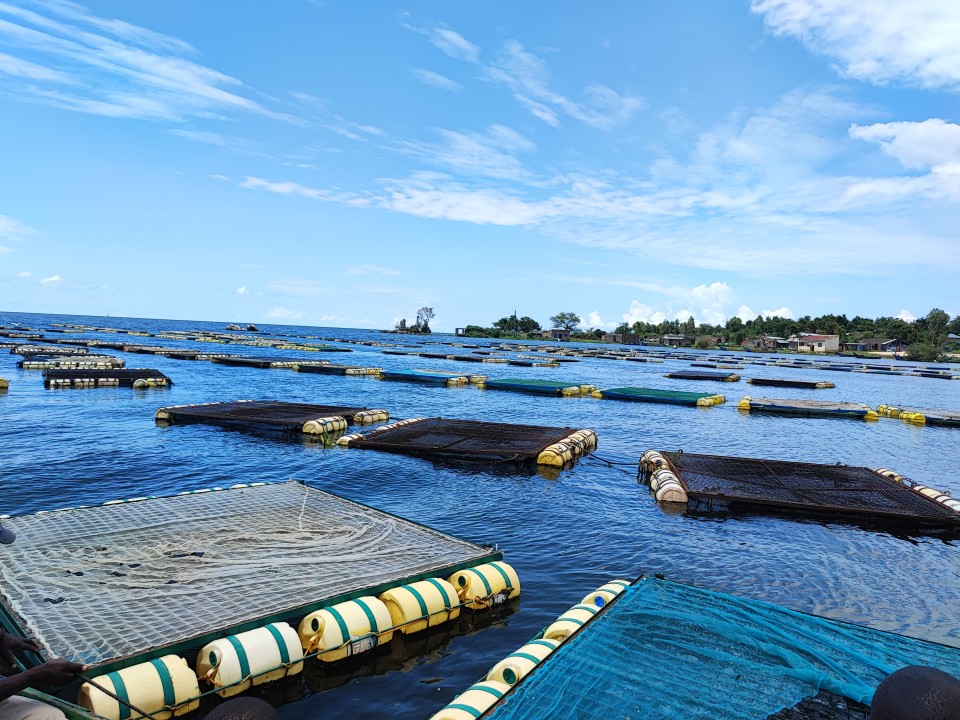
Intensive aquaculture is growing rapidly in Africa.
On Lake Victoria alone, there are more than 9,000 fish cages holding billions of fish. Today, intensive fish farms are facing mass fish deaths and high economic losses for farmers.
0+
fish cages on Lake Victoria alone, holding billions of fish.
Mass fish deaths. Real losses for farmers.
Better welfare and better farming go together — for the fish and for the people who raise them.
The world is moving from catching fish to farming them.
View the data
| Year | Aquaculture (M t) | Capture (M t) |
|---|---|---|
| 1990 | 13.1 | 84.8 |
| 2000 | 32.4 | 94.8 |
| 2010 | 59.9 | 89.1 |
| 2020 | 88 | 90 |
| 2022 | 94.4 | 92.3 |
In 2022, aquaculture surpassed capture fisheries in aquatic-animal production for the first time. Figures are approximate; 2020 values are rounded.
That changes the welfare equation.
Sources
FAO, The State of World Fisheries and Aquaculture (SOFIA) 2024. · Mood, Lara, Blythe, Brooke & Comfort (2023), estimates of farmed aquatic animals and welfare-knowledge coverage, 2018. · FAO regional aquatic-food supply and demand projections for Africa to 2050.
Improving the lives of fish across Africa.
The world needs
more fish.
Fish need better welfare.
Aquaculture is expanding quickly across Africa, and Kenya is at the heart of that growth. But our knowledge and practice of fish welfare have not kept pace with the scale of the industry.
What are we doing about it?
Stakeholder Engagement
We propagate discussions on fish welfare with fish experts, fish farmers, policymakers, and the public in Kenya.
Research
We collaborate with research institutes to conduct fish research in Kenya.
Advocacy
We speak up for the interests of fish and make recommendations to improve fish welfare to farmers and policymakers.
Become part of the solution
Fish welfare needs more people paying attention
We work to build the engagement, research, and advocacy that fish welfare in Kenya needs. Whether you can offer funding, research capacity, or time — there's a place for you here.